← Back to projects
Plant-based laboratory
JF LAROSE Laboratoires
Every order arrived as a phone call or a private message, and the delivery price for the buyer’s own commune had to be looked up by hand each time. Nobody could say afterwards what had been shipped where.
Next.jsNestJSE-commerceFR + AR (RTL)
The result
Orders arrive priced for the buyer’s own commune, and the courier paperwork prints itself.
- The problem
- Every order arrived as a phone call or a private message, and the delivery price for the buyer’s own commune had to be looked up by hand each time. Nobody could say afterwards what had been shipped where.
- What I built
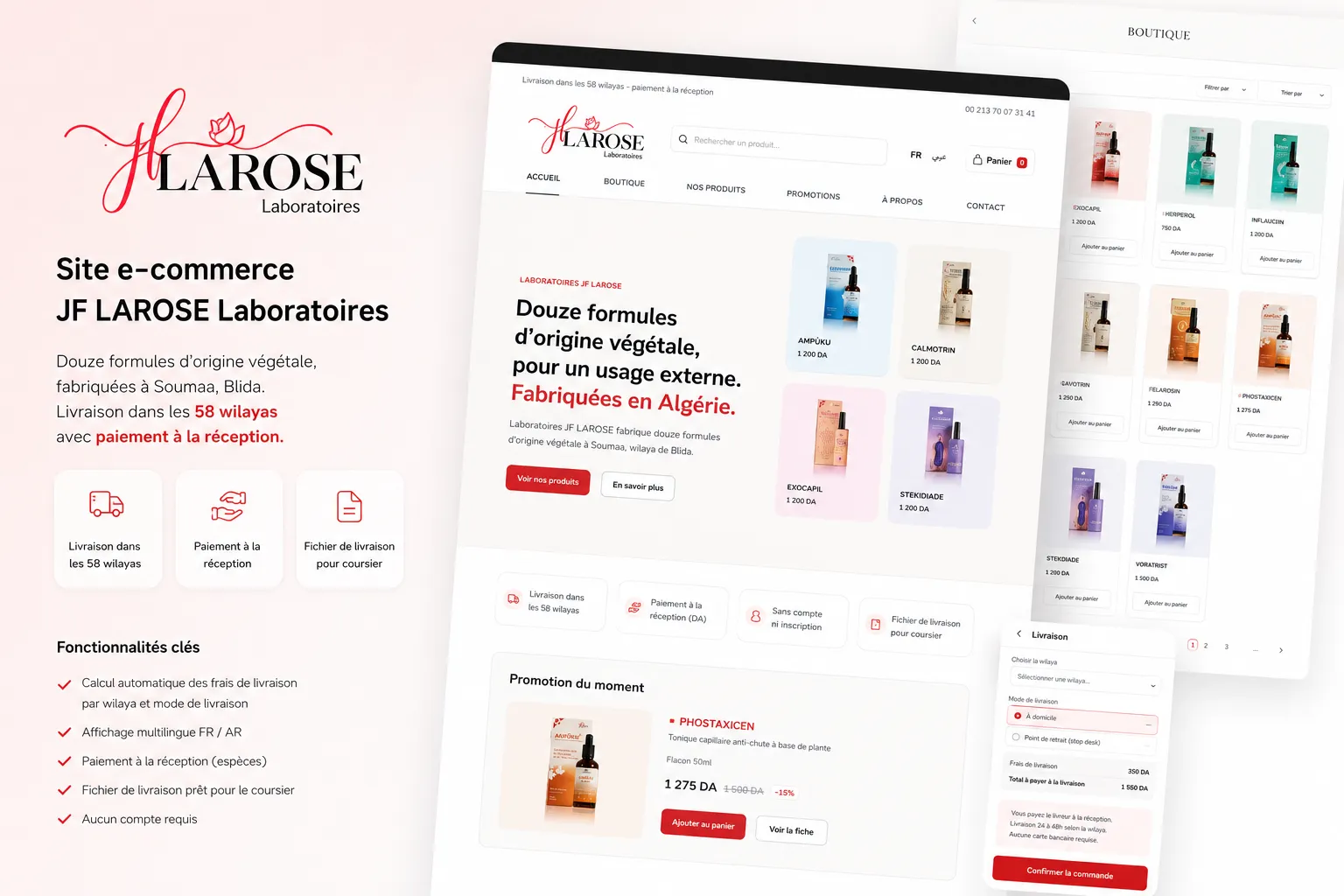
- A shop in French and Arabic where the customer pays on delivery, the price for their exact commune is already known, and the team runs the catalogue, the orders and the courier paperwork from a back office.
- The result
- Customers across all 58 wilayas order for themselves in the language they read, and the courier slips print instead of being written out.
The brief
JF LAROSE Laboratoires manufactures twelve plant-based, external-use formulas in Soumaa, wilaya de Blida. They sell across the whole country the way Algerian commerce actually works: the customer orders online and pays the delivery driver in cash at the door. No card, no bank details, no account required.
That sounds simple until you price it. Delivery costs a different amount in each of the 58 wilayas, and differs again between home delivery and a stop-desk pickup point. The shop has to quote the right figure before the customer commits, in French or in Arabic, and then hand the courier a file their own delivery company can import without editing.
What the customer sees
A storefront in French and Arabic — a real right-to-left layout, not a translated afterthought — where visitors browse the twelve formulas by what they need rather than by category: pain, digestion, circulation, hair, cold, and so on. Search tolerates missing accents, because nobody types « détente » with the accent on a phone.
Checkout is three steps: basket, delivery, confirmation. There is also a shortcut — on a product page the order form is already open, so someone who wants one bottle enters their name, phone and wilaya and is finished without ever seeing a cart.
- No account needed to order: a visitor checks out in one pass, while registered clients keep their order history.
- A live delivery quote per wilaya and per delivery mode, with free home delivery above 5 000 DA.
- Order confirmation by e-mail, plus an order number both the team and the customer can quote.
- Password reset by e-mail and a 5-digit code — one flow for clients and administrators alike.
- Written for Algerian law: terms of sale and a privacy policy referencing loi 18-05, loi 09-03 and loi 18-07.
The back office
The team runs the whole shop from a French-language admin panel with no developer in the loop: dashboard, products, orders, clients, contact messages and settings.
Two parts of it earn their keep every single day. The delivery grid holds a price for all 58 wilayas and 1 548 communes and travels as an Excel file — download it, reprice it in a spreadsheet, upload it back. And the carrier export writes the delivery company’s own eighteen columns, spelled and ordered exactly as their importer expects, for every confirmed order in a chosen date window.
- Products: create, edit, price, discount, hide from the shop, and upload up to six photos each.
- Orders: the cash-on-delivery lifecycle — new, confirmed, shipped, delivered — plus cancellation.
- Delivery prices: per-wilaya and per-commune overrides, editable in the panel or through Excel.
- Carrier manifest export in Excel or CSV, ready to hand straight to the delivery company.
- Shop-wide switches: the free-shipping threshold, and whether promotions run at all.
The team changes a price, hides a product, reprices a wilaya and exports the day’s deliveries — without calling me.
Under the hood
The storefront is Next.js 15 with React 19 and strict TypeScript, server-rendered, with next-intl driving the French/Arabic routing and zustand keeping the cart across reloads. The API is NestJS on PostgreSQL through Prisma, product photos live in MinIO object storage, and the session is an httpOnly cookie. The admin panel is part of the same Next.js app, behind a role check enforced on the server — never only in the browser.
One decision is worth calling out, because it is what keeps the two halves honest: every shape that crosses between the front end and the API is declared in a single file, and a backend test reads that file at run time. Change a field on one side without changing the other and the suite fails. Prices are integers in dinars everywhere — no floating point, no cents, no rounding surprises.
- Money is never trusted from the browser: the shipping fee and the order total are recomputed server-side on every order.
- Uploaded photos are validated by their magic bytes, not by the type the browser claims.
- Contract parity is enforced by an end-to-end test, so the API and the storefront cannot drift apart.
- Built pixel-exact against a frozen design reference, checked at 1440, 1024, 768 and 390 px.
My role
I built all of it at Sadeem Informatique: the storefront, the NestJS API, the database and its seeding, the object storage, the admin back office, the delivery pricing, the carrier export, the transactional e-mails and the test suites. Front end and back end, end to end.
The outcome
The shop is live at store.jf-larose.com. Twelve products, 58 wilayas, two languages, cash on delivery — and a team that runs its own catalogue, prices and paperwork without touching code.
Your project starts with one message
First call is free, 20 minutes
Write what is eating your time or losing you money. I reply within one working day with a plan and a price — and if I am not the right person, I will say so.
- 01
- You send the message; I reply within a working day with a few questions.
- 02
- A 20-minute call to understand what you actually need.
- 03
- A written plan with a clear price and timeline, no commitment.
Tell me what you need
Questions about Haithem? Ask the assistant.