← Back to projects
Personal project
Life Quest
Browser platformers ship megabytes of sprites and audio before the first frame draws, and online play usually needs a server somebody has to pay for.
TypeScriptCanvas 2DWebRTC Co-opWeb Audio
The result
Four bosses and online co-op, with zero image or audio files shipped.
- The problem
- Browser platformers ship megabytes of sprites and audio before the first frame draws, and online play usually needs a server somebody has to pay for.
- What I built
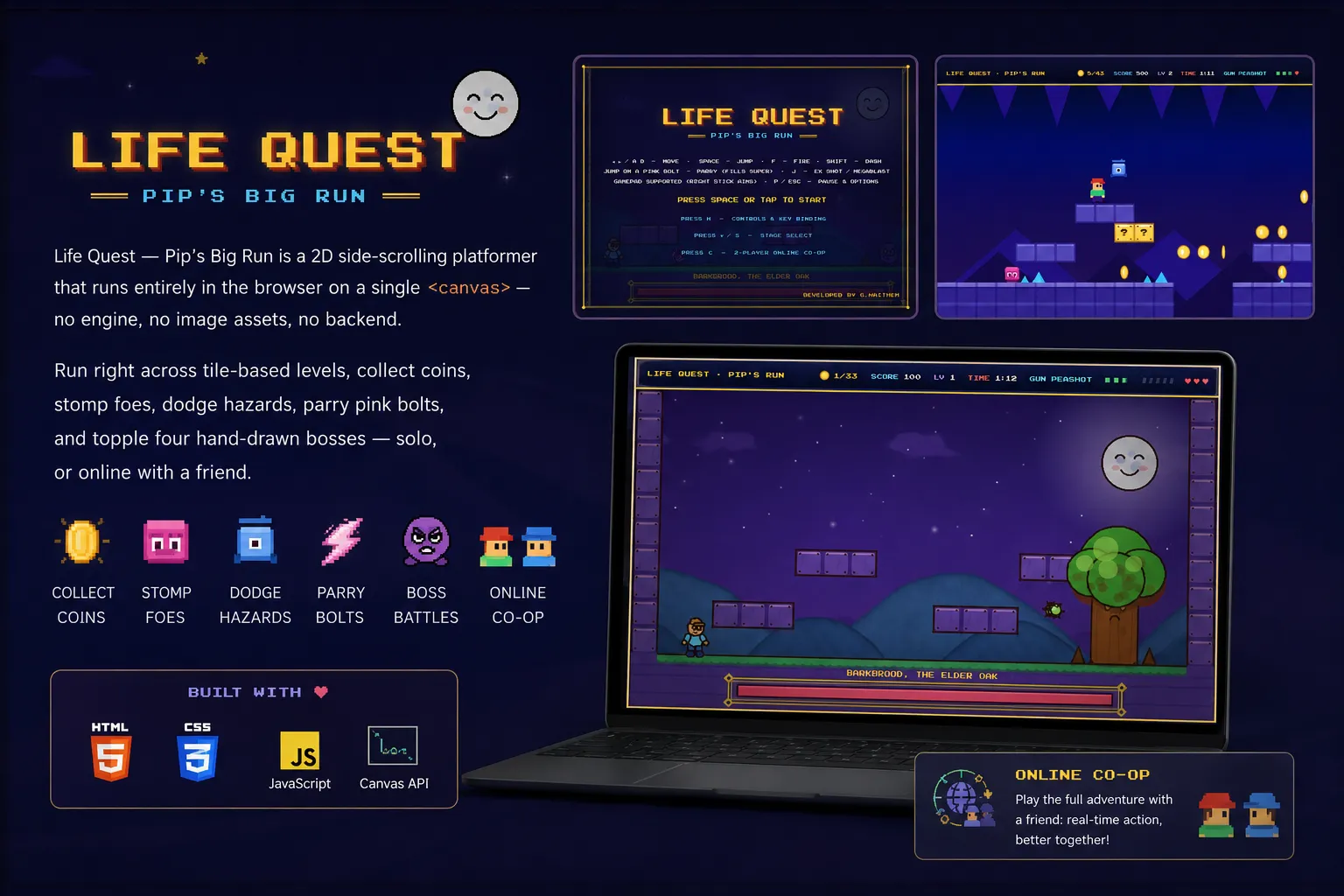
- A game with no assets and no backend: the 1930s rubber-hose art is drawn live on a canvas every frame, every sound is synthesized, and co-op runs peer-to-peer over a four-letter code.
- The result
- Four hand-drawn multi-phase bosses, two switchable art styles and online co-op — with not one image or audio file in the repository.
The game
Run right across tile-based levels, collect coins, stomp foes, dodge hazards, parry pink bolts, and topple four hand-drawn bosses — BARKBROOD the elder oak, GRANITE the stone golem, RIME the ice spire, and THE OVERCLOCK, an airborne finale. Four biomes — golden-hour meadow, crystal cavern, industrial foundry, and a moonlit boss arena — each ship their own palette and parallax backdrop.
The full platforming kit is there: variable jump, duck and fast-fall, dash, wall-jump, shooting with 8-way aim, a parry, moving and crumbling platforms, and checkpoints. It plays on phones too, with auto-detected touch controls, auto-fire, and a layout that respects notches and the mobile address bar.
Drawn and synthesized at runtime
There is not a single image or audio file in the repository. The Cuphead look — ink-outlined curves, boiling lines, and a warm vintage film grade — is rendered live every frame on the Canvas 2D API, and a clean Mario-style pixel path ships alongside it, switchable at any time. Every sound effect and music track is synthesized with the Web Audio API.
- Two switchable art styles: rubber-hose Cuphead ink or clean pixel art.
- Per-biome renderers: sky, sun and moon, hills, stalactites, girders, embers.
- Fully synthesized SFX and music — zero audio assets.
- Accessibility built in: difficulty tiers, reduced motion, colorblind-friendly UI.
No engine, no assets, no backend — everything on screen is drawn, and everything you hear is synthesized, at runtime.
Online co-op with no server
Press C on the title screen, share a 4-letter code, and a friend drops into the same world — same enemies, same bosses, combined boss damage. The connection is peer-to-peer over WebRTC: a public broker handles only the initial handshake, then all game data flows directly between the two players. The host runs the one authoritative simulation while the joining player’s character is predicted locally, so movement feels instant instead of waiting on the network.
Engineering
The codebase is strict TypeScript on Vite with a fixed-timestep loop that decouples physics from frame rate. The render layer never mutates state, all gameplay constants live in one file, and every level and boss is an authored JSON file — adding a stage requires no physics changes at all.

Your project starts with one message
First call is free, 20 minutes
Write what is eating your time or losing you money. I reply within one working day with a plan and a price — and if I am not the right person, I will say so.
- 01
- You send the message; I reply within a working day with a few questions.
- 02
- A 20-minute call to understand what you actually need.
- 03
- A written plan with a clear price and timeline, no commitment.
Tell me what you need
Questions about Haithem? Ask the assistant.